
From Ideas to Impact: How Adaptive Organizations Win in Execution and Innovation
Ideation is the essential foundation of innovation and the pathway to impact. We use it to solve problems for ourselves, our loved ones, and the world around us. It gives us possibility, hope, and a vision for the future. When done correctly, it can lead to meaningful change. But how can we balance the urgent need to harness the power of our ideation with the realities of our human constraints?
Our world today is defined by competing priorities, constant change, and limited capacity. Individuals are expected to navigate shifting demands, make decisions amid uncertainty, and translate intentions and ideas into action. This, all while balancing work, family, health, and an ever-growing stream of information. This challenge does not stop at the individual level. Naturally, people bring their habits, pressures, and patterns of execution into the organizations where they work. As a result, the broader societal struggle to turn good intentions into consistent action often translates to fragile organizational impact.
Across industries, today’s companies are not suffering from a lack of ideas. In fact, most are saturated with strategies, initiatives, and transformation agendas designed to drive growth and performance. Nonetheless, amid the genuine intention to innovate – meaningful, sustained impact remains elusive.
At Virtuous Growth Solutions (VGS), we believe the true challenge and risk to organizational growth and transformation is not mediocre idea generation -- it’s what we call The Impact Gap.
The Impact Gap - What is it?
The Impact Gap is the space between intention and impact. It's a variation between the goals we set and what actually gets adopted, executed, and sustained. It often emerges when innovations are designed with implementation as an afterthought. Or, arguably worse though strikingly common – when the people, processes, and systems needed to translate those ideas into action aren’t involved in the design process.
When this happens, a familiar pattern emerges across industries:
Bold strategies are developed
Initiatives are launched with enthusiasm
Adoption is inconsistent
Execution becomes fragmented
Early momentum fades
Competing priorities take over
Results plateau or fail to materialize
At its root, the issue is rarely the quality of our ideas. Instead, the true enemy of impact is poorly supported people with poorly nurtured ideas. Organizations struggle when employees and clients are ill-equipped with the capacity, clarity, or support to adopt change. We lose the value of true innovation when our processes don’t enable execution, our performance is invisible and unmeasured, and our systems aren’t designed to sustain what works.
Driving Impact
Driving true impact requires us to create conditions where people can connect proposed change to their priorities, embrace the change, and act on it. Leaders and organizations must support execution by equipping people with the appropriate knowledge, tools, and resources – the most important of which is personal connection to change.
“What’s in it for me?”
“What’s in it for me?”
Lastly, we must build systems that can sustain and evolve what works over time – harvesting and applying to practice lived experiences of those we’ve created the change for. This requires a shift:
From perfection → iteration.
From linear execution → cyclical evolution.
From individual effort → shared capacity.
From assumptive adoption → intentional feedback loops.
From launching initiatives → proactively sustaining their performance.
The 6P Adaptive Cycle
6P Adaptive Cycle is a practical, human-centered framework designed to help organizations move beyond strategy and into continuous, measurable impact.
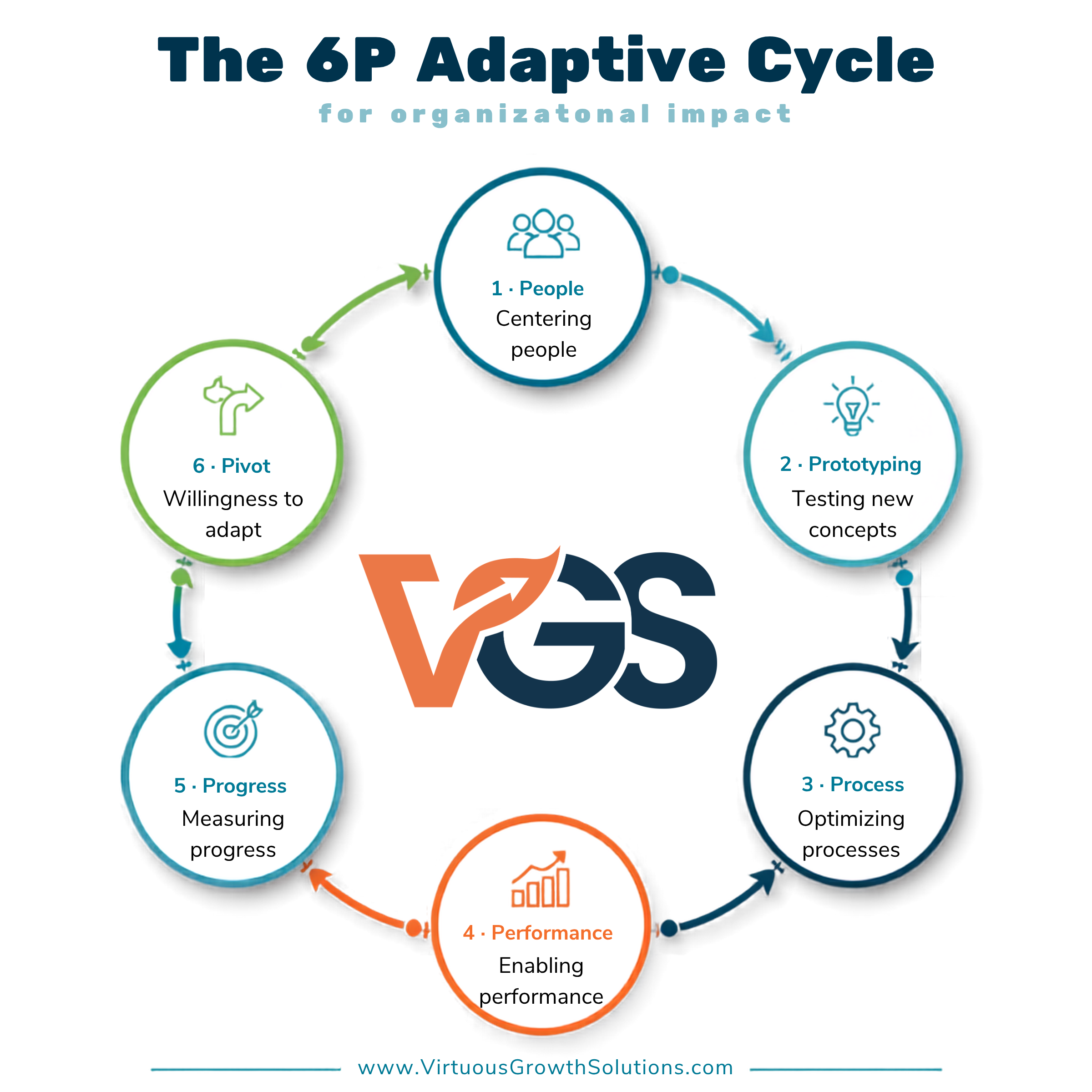
People — Centering the people who make change possible
Prototyping — Testing new concepts before scaling them
Process — Optimizing processes that enable impact
Performance— Creating the conditions for people and systems to perform
Progress — Measuring what matters, celebrating progress, and learning from results
Pivot — Willingness to adapt based on what the organization learns
Together, these six elements create a continuous cycle for closing the Impact Gap; remedying the disconnect between what is envisioned and what is realistically adopted, translated into practice, and sustained.
Conclusion
In a world where demands are constantly shifting and ideas are abundant, execution is the true differentiator. Organizations that create lasting impact are not those with the best strategies or the most abundant ideas, but those that can move an idea from strategy → adoption → execution → sustainability → evolution.
They engage their people, test and learn quickly, build scalable processes, enable performance, measure what matters, and adapt continuously. The future belongs to organizations that don’t just ideate—but leverage discipline and intention to nurture ideas into impact.
Ready to close your Impact Gap?
Great ideas deserve more than a launch. At Virtuous Growth Solutions, we help organizations turn intention into lasting impact by designing the people, processes, and systems needed to make change work. Click below to learn more or connect with us.
